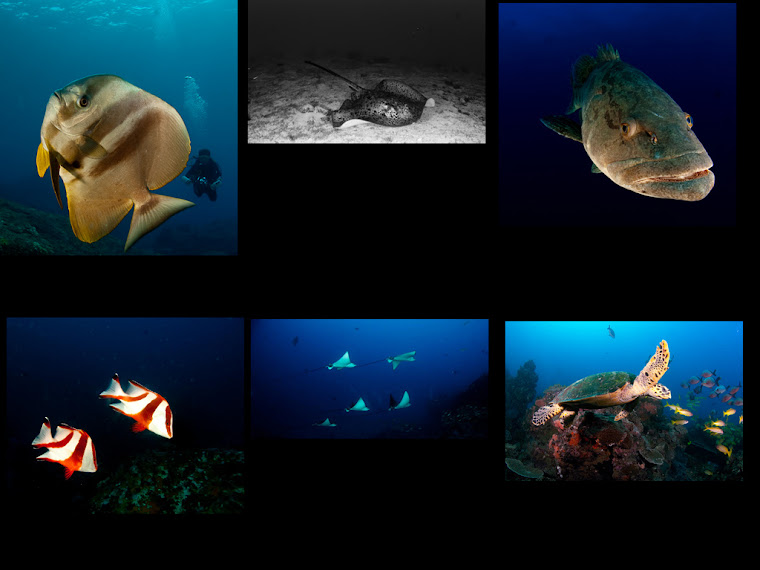
Portfolio

Portfolio

Sunday, February 3, 2013

Back to diving...2012-2013 in Eden

Cool warm  water or warm water with a slight chill awaits us at Harrison's Rock. Temperature is only 27 degrees! This is our first dive of the 2012 Summer season. Sue and I have two guests Lauren and Linda, both advanced divers  so we descend effortlessly down even after the long lay-off. My last dive was in February...I have not yet dived with Linda, my niece and her friend Lauren and look forward to the experience.

Harrison's is not best dive site in Seychelles, but a good check out dive for a team of divers that have not dived for a while. The viz is not great but we see a very large school of silver bat fish. Looks like the school has now moved from Isle Seche where they held court last year. Sadly it appears we have missed the glass fish season so no "karang" (golden trevally or king fish) hunting posses this year. Only a short sighting of the resident white tip reef shark gets the adrenaline going.

The  next day we do the twin dives at Isle Seche, staring with Pinnacle. We can consider both as average, no  great viz, but we see a turtle and just being underwater is adequate compensation anyway. Afterwards we visit neighboring island of Moyenne, owned by the late Brandon Grimshaw. I discuss this island separately.

On Wednesday we do the Shore Dive at Anse Bernitier. A great logistical experience and success discussed separately. The viz is not great,  but fish life and quality of coral superb! A first on Eden, a hidden secret surely.

On Thursday we head to Johnnies. This remains one of the best dives in Seychelles. The coral is superb and fish life very good. Our viz is fabulous and we spend a wonderful hour underwater.

On Friday its the last diving day with our guests and we decide to do another double tank dive . It is a fabulous day and we head to Brizaire the legendary Seychelles signature dive. The Bizaire rock is next to the twin dive, Dragon's teeth. The viz she was endless and we see the resident school of barrucuda, some eagle ray and two white tips. The coral garden and large schools of snapper and big eyes remain a sight to behold.
Our second dive is Lilotte and sadly the viz lets us down. We return to base ready for diving in Seychelles this season!


Sunday, February 5, 2012

Indian Glassfish or Parambassis ranga

The more I dive, the more stuff we see and learn, says Clive. I am sure you must agree with me. One of the things that have lately struck me is how limited our knowledge is and that also goes even for revered  fish ID books like those of Helmut Debelius (Indian Ocean Reef Guide, and Red Sea Reef Guide), not to mention the bible of Southern African fish by Dennis King (Reef Fishes & Corals).


Let me give some examples of what I bitching about. Take the common Indian glass fish, Parambassis ranga or chanda ranga. It fails to get a mention in any of the three books of Debelius and also not on the Dennis  King I have. Yet the fish is very prevalent in Indian ocean waters (at least in Seychelles) and not only in aquariums. In a previous blog I discussed the annual Ranga Tanga.The glaring exclusion of glassies from the above  learned books remains  a mystery to me. Neither do they get a reference in Neville Coleman's Marine Life of the Maldives. Some  examples of the fish we talking about are set out in pictures  below.

                                                       (Close up courtesy-  Sue Ferreira)


                                                                      Even the resident turtle is coming for a peak.

Another  example of undefined or incomplete information is the different names for the karang (creole name) or golden trevally/jackfish or king fish. (This fish depicted below) There certainly also appears to be some confusion regarding the name in different parts of the world! Also have  a look at sting rays and see if you agree with me. Total confusion as we seem to have different names or an incomplete collection! There are some  other examples like this which you can spot in your own good time.

                                                     Karang on the prowl!

Finally Dennis calls the fish below a starry puffer fish and Debelius a giant puffer fish! They certainly got the Latin name (arothron stallatus ) right, but clearly they did not collaborate on local names used.


The only conclusion I have come to is that we really are only beginning to unravel the ocean. Both Dennis and Debelius have spent a  life time in producing extremely useful books. Without them we would have been lost underwater! We sorely need more of these and more information.

Knowing the time and cost of only one dive and the short dive times we have as well as the fact that the "underwater actors" have their own businesses to mind and are not "waiting" on us to come and snap them, I think it is a very simple fact  that we still lack so much knowledge. Please help on your next dive and bring some knowledge back.

Thursday, February 2, 2012

The hunt for (Red October) Silver Bat fish...

So we (Sue and I ) thought we just would jump in for quick dive at Isle Seche after a spate of bad weather. We had guests on board Suzy Q and while we dived they went snorkeling. We did not expect much, after all it was only Isle Seche and not a highly rated dive site. I paid scant regard again and did not take my camera, choosing to hold onto a buoy nogal!

What spectacle awaited us. The boulders were covered in glassies with big posses of Karang (Golden Trevally in Sesel Creole) stalking. Hovering above the glassies  was a very large school of bigger silver bat fish enhancing the scenery in beautiful symphony. (I had to consult my fish book as they are not too common in Seychelles). They are also called diamond fish and appear to be endemic to the Indian Ocean. It was a site to behold and I just knew we had to come back with a camera.

So there we went for two further times and each time, nada, no site of the damsels. I even consulted special agent Tamara of Angel Fish Diving (underwater). She investigated and reported that I should move my attention to Isle Seche Pinnacle  and not Isle Seche Grande. So off we went to Pinnacle! I wonder how many Pinnacles and Aquariums there are in the world....

We moved our drop-off the required 100m and dove. We found them, voila. Now what is this, why is my flash not firing? The cable seemed to be badly connected and no flash fired, au naturel, today, buddy during amateur hour.  I was able to take some photos, but remained bitterly disappointed.

So off we went again and again we struck a problem, bad wind, large waves, very strong current and Sue had free flowing regulator. When we hit the bottom she was already on 120 bar. We decided to continue as Pinnacle average was below 10m and she was light on air. After 9 minutes finning against the strong current, we are back on the boat. We go back a few days later in splendid conditions and this time I am more satisfied but I still need to go  back. See some of what I talking about below.


Agent Tamara


Wednesday, February 1, 2012

My Buddy did it!


My buddy did it!


Underwater photography as we know is a frustrating work in progress. One cannot progress however without being in the water with a camera in hand. Then one day the sun aligns with the moon and the actors perform at perfect exposure in aquatic bliss.The following achievement speak to this point.

My wife (and wayward buddy) Sue has just achieved a wonderful accolade. She has cracked a bronze medal (gold, silver, bronze) for the category “Macro: Not Swimming” in the prestigious 2011 Underwater Photography image competition. (Sneak   results just out on the web site   www.underwaterphotography.com).

The image depicts an unusual  unique (family?) collection  of seven geometric eels as attached below. This stunning image was taken at our favorite house reef “Johnnies Rock” off Mahe  in the Seychelles. I have written a few times on my blog, (divewithclive.com)  about this wonderful reef. She  took the shot he shot while the family resided for quite a while at a particular point that was a landmark during dives and while there were always a number of eels, the most Sue got previously was five in one shot!

So the question is asked many times,why shoot photo's and accumulate expensive Gigabytes on your computer? Clearly once you have dived a few times talking images makes the dives more pleasurable while also (with some frustration) improving your skill. From time to time you may  also enter competitions which may equally be a burden/pot shot  given the high degree of competitive biase that sometimes emerge in addition to all the luck required. You also enter many times without even a nod that it is sometimes questioned: is it all worth it, given the significant investment?

Now Sue has cracked a big one! The shot was one of more than 11 000 entries from 130 countries. Some 1200 shots were selected for final evaluation and over the last month we have seen her shot creep through the various eliminations to ultimately achieve the only medal for South Africa and (Seychelles).

Needless to say I am extremely proud of my intrepid buddy who takes no prisoners as we all know and now has once (again) also taken the winning shot. Please join me, her proud buddy and hubby, family, friends and fellow divers in congratulating her on this stupendous achievement! Go Sue!


Friday, January 6, 2012

Views from Eden

Eden island is already more than 5 years old

The development is now taking great shape and the new Eden Plaza shopping centre is nearing completion. The  apartments, maisons and villas are about 70% complete with circa 350 units sold.

The marina remains busy (despite) the Somali pirate activity preventing many super yachts from visiting during the winter in the Med. Last summer the beautiful new 85m Sunray (complete with helicopter) was the main attraction This summer it is the equally lovely 110m Radiant that has graced our shores.


To provide some better understanding of  Eden island (my base in Seychelles) see attached  visual material telling hopefully better than words of the beauty of my hangout.

Revisit the tracks

Like Game Drives, Dives are never the same even if you go to the same site on consecutive days or even on the same day. Just ask around I am sure everyone will agree even Andrew.

So there I went back to Ille Seche, remember my blog, -The First Rule of Diving-I was particularly interested to shoot the large schools of silver fin bat fish hovering above the larger schools of glassies with the posse of golden trevally patrolling and having the feast of a lifetime as part of the annual ranga tanga 
(see previous blog).

The day was a scorcher, as only the Seychelles can serve up. Blue skies, no wind, flat seas.....I decided to go early and take those wonderful photos I did not take the day before. We jumped in and the viz, she was great. Well here is the report card!

[Some] of the glassies were still there, but much less of them. There were a few stray (overfed) golden  trevally around, but they were not too busy. None of the large schools of silver fin bat fish made a showing. In fact I could not even see one. So just as I was starting  to hitting despair, I saw a large boulder (Seychelles diving consist of diving around boulders with coral)  covered in glassies. Suddenly I also spotted my favourite animal as I saw a small hawksbill turtle glide towards the boulder as well. I followed him and took some nice once. I also spotted him later towards the end of our hour long dive.


Suddenly the reef was alive once more as this time a never ending school of fusiliers swam past and then followed by smaller posse of golden trevally. I post pictures of the two schools and then also a collage of the dive. Enjoy....


Wednesday, January 4, 2012

The first Rule of diving.....

So I rediscovered Ille Seche or Beacon Island today. (Just of Mahe in Seychelles for non-Sechellois) We have not dived there for some time and not really at the right spot as we discovered. We had spectacular 20m plus viz, a mild current, but what a show the animals put on.

We saw thick schools of glassies ( part of ranga tanga) with large schools of silver batfish hovering above them followed by an endless, (probably the largest ever school  witnessed by man) Golden Trevally....(jackfish, kingfish)  wow...I just hanged there as the schools patrolled passed in their frenzy food fest.


( The site is almost of map below in NE corner)

Sadly I was hanging onto  a buoy while wife Sue was shooting some interesting macro .....she also managed .some great shots of PINK jellyfish.

I had once again broken the first rule of diving if you call yourself a photographer....TAKE YOUR CAMERA ALONG DUDE!

Going back tomorrow, but with my luck that school of trevally will have decimated the glassies and the viz will be sh....The other lesson is. NEVER DISCARD a dive site, especially the one on your doorstep.

Lets hold thumbs! Wish me some luck please.

Monday, January 2, 2012

Glassy (sardine) run -Parambassis ranga (tanga)


Glassy (sardine?) run -Parambassis ranga (tanga)


Migrations or mass animal behaviour fascinate man and facilitate wonderful photo opportunities.
We all know about the wildebeest (and zebra) migration in East Africa, the sardine run in South Africa, the whale shark of Seychelles and many others. As some know I am a (keen) diver and photo man. I am also a great Seychelles supporter (together with Springboks, Proteas and Man United). I am happy to report that I may have discovered something, I think so in any event. I have been diving the Seychelles now for five years and have observed something interesting, for me at least. I call it the Glassy run! or Ranga tanga!
Every year around December (if it was a good year) it appears that millions of glass fish or parambassis ranga hatch and congregate in giant schools  around the large granitic coral rock underwater in Seychelles. I have now regularly witnessed these around my favourite dive sites off Mahe (Harrisons, Johnnies, Turtle rock). The glass fish attract large schools of giant and golden king fish or trevally (Gnathanodon speciosus)  (or is it jackfish?-Fish names vary across the globe) that feast on the glassies. Other fish like rock cods join in the fund and voila we have a mini sardine run or a parambassis ranga tanga!    As a diver it makes for an awesome experience when these large schools of trevally patrol past you, a few minutes after you arrive on the scene of their feast. Needless to say some good photos may be shot if you remember to push the button and get your framing etc. done.

Sadly it appears that the local fishermen have also caught in the act and they now send out  a small flotilla to harvest trevally when the tanga happens. It reminds me of the chokka boats of Jeffreys Bay (East Cape) which I also saw getting of the ground in similar fashion in the early eighties. I thought it necessary to record and submit my amateur observation of the ranga tanga for comment. (My buddy partner Sue is my witness as is my old collaboteur, Andrew Kemp and his partner Fernanda when they were with us in 2010)

This year was special for me as I had not dived since early January for medical reasons.-I had a total hip replacement earlier this year and it was advised not to dive for at least four months. I made the successful return on the 14th of December at Johnnies and to my great surprise and happiness the glassies were there. I could not see the swim thru at all, one black hole only. It was not long when we were surrounded by the posse or rather the cavalcade or large school of golden and giant trevally. Awesome sight! They just roll by, nosy and inquisitive and then disappear as suddenly as they appeared, only to return at least once more during the dive. The next day at Harrisons the flotilla was there before us and we had a dive and a similar experience, although we missed the reef initially when three giant buffalo parrot fish diverted our attention. We sadly carried no cameras as I was still building up to diving with camera again.

Two weeks later I thought the tanga was gone when we finally went for a dive (with cameras). As we dropped into perfect viz at Johnnies I was overwhelmed and almost wet my pants (forgive the pun) when I saw the glassies were still there. It did not take long for the posse to arrive. I have some evidence this time…..see below.

Oh by the way it is great to be back as a diving photographer. Wow, did I miss it! Also is the coral not looking great! I have noted a succinct improvement over the last twelve months.


Owning paradise


So what about owning paradise, your own paradise…
Sounds like a good idea…to me at least… while we are around ….for the moment. One man has done this and lived on it for virtually  the last forty years. Meet the owner of Moyenne (the middle one), Brendon Grimshaw. He bought the island with his father  in the late sixties and has lived here since then, outlasting his friends. Now in his mid-eighties he remains in good health and is the main source of information to daily tourist visiting his island.  
It is an ideal stop over for day tourists. All you do is hire a boat or even take your own boat or kayak and saunter across from any of the neighboring islands and voila you are in Brendon’s own private reserve. The smallest marine park in the world-the Moyenne Marine  park!  There  you can snorkel, lie on the beach or take a walk around the island, all at leisurely pace. One may even do some treasure hunting as a pirate’s treasure is supposed to be hidden on the island( nothing found yet), or one can have some refreshments and a light meal at the Jolly Roger after/during your island visit!
The island takes about an hour to circumvent at your leisure. There is much to see and do. The island has been reclaimed painstakingly by Brandon and his local friend Rene Lafortune. The latter has since sadly departed. You find most [all] of the indigenous plants and trees of Seychelles. There is also a small museum with some interesting facts on the island, some known and unknown graves and even a small chapel.
Moyenne was first inhabited about 160 years ago when it was given as wedding gift to its first two citizens. People stayed on the island until after World War One after which it became desolate until Brendon ( a journalist) came here in the late sixties and bought it in and started living there with his father and friends. Together they restored the ideal to its past glory and present state.
Brendon lives on the island together with about 160 giant tortoises. Seychelles and the Galapagos islands are the only place on earth where these giant slow coaches are found.  He has an annual out of country health check, otherwise his routine is to get weekly provisions in Mahe together with the local Rotary Club lunch!
Brendon is a key person to understand the solitude, bliss and lack of stress of his chosen life style. Is it a style for everyone, not sure about that but he certainly looks young for his age so then we should think again. The question remains how do you kill time, ask Brendon on your next visit. Ideal to cure writer’s block and nowadays with the cloud one can be anywhere even on Moyenne, assuming you have 3G.

All very civilized and distressed! Enjoy Moyenne!; Only a short twenty minute boat ride from either Victoria harbor or Eden island marina; Right next door to St Anne and Cerf island. If you cannot get there soon  have a look below.


Sunday, December 4, 2011

Monday, November 28, 2011

Kapama

Our company Fieldstone held a very successful offsite recently at Kapama near Hoedspruit.

We were blessed with some awesome lion sightings in addition to the big 5 and some other wonderful encounters. Pictures tell more than words! Enjoy.

Wednesday, November 16, 2011

Some more detail photos from Sue taken at Motswari. Enjoy some spectacular shots!

More Motswari

More shots from Motswari, looking fowrad to Kapama
Posted by Picasa

Sunday, November 13, 2011

I attach a short video giving a taste of Eden Island and Seychelles above and below water.

Sunday, November 6, 2011

Turtle delight


Sweet memories of Doodles

Turtle mania!

I guess each of us has a soft spot, something that gets him going, pumps the adrenaline, makes one feel good. That experience for me (as most my friends know well) is seeing and spending time with a turtle, underwater . Turtles are graceful, lovable, beautiful creatures that make great photo subjects. Over the years I can truly say they have been my number one target, difficult to find, unpredictable but always fun, if they will let you come close. Sadly turtle meat is still on the menu in some countries and many, many of them get stranded in shark and fish nets worldwide. They get killed of indiscriminately and for mo good reason. Man has become their mortal enemy.
There are about 5 main types of turtle (hawksbill, loggerhead, green, leatherback, Ridley) and they can (hopefully) still be found on coral reefs near you. Turtles have a very long live span (sixty plus) if they manage to survive the modern mantraps. They continue to make a positive contribution to the ecosystem and we need them to feel good about ourselves. Most turtles start life from a deserted beach where their mother nested and was also born. A typical nesting will hatch around two hundred eggs. The mother arrived there x weeks before and laid the eggs on the beach about 500mm below the surface in a hole above the high water mark which the mother made and after laying the eggs covered up the nest to protect against scavengers. A few weeks later the eggs hatch and the small turtles make their way to the surface to start their lives. Many will not make it but hopefully most will. They have to face many predators along the way. On land they face crabs and birds and in the water sharks and others are only to eager to grab this tasty morsel. The mother probably made several nests, laid lots of eggs to ensure survival of the species. Worldwide such secluded beaches are getting fewer. A few weeks ago I was privileged to spend the weekend on Bird Island, Seychelles, home of the brown Noddy and many other terns and tropical birds.
It was nesting season for the hawksbill and green turtles. When we were there a total of 250 hawksbill and 30 green turtles and had nested already. Clearly it was a concern that there was such a low number of green turtles, equally was 250 enough for the small hawksbill? We were fortunate to witness the nesting of one hawksbill during day time. The local conservationists collected the eggs after a few weeks and allow the turtles to hatch in a protected environment to avoid some hungry lucky land crab along the way. It was therefore a regular nightly occurrence to release a batch of hatchlings under “controlled conditions” to ensure the maximum number reach the relative safety of the ocean. We wished them a very good voyage.
The nesting we witnessed was quite dramatic. Although Bird Island is very remote with limited humans there always is some activity during on the beach. This activity may deter a nesting from happening despite nature’s call. A female turtle ready to nest will check out the beach for a clear patch and start his crawl up the beach. If disturbed before digging the hole, she will dart back for safety. We were called and found the tracks of such an attempt but ware told to hang around as she would return in the vicinity. Within 30 minutes we were called and within 300 metres she was digging a hole! We kept a safe distance but as soon as she started laying we were allowed closer and even the nest was opened up where we witnessed the actual laying. The whole procedure took about 45 minutes where after she safely returned to the nest and we made sure the nest was as well protected as possible.
This wonderful event made me realize how fortunate I am when I encounter one of the fully grown specimen of any of the species. Please help all to take turtle off the menu!
Turtles to me remain a wonderful experience as seen below.


Saturday, November 5, 2011


Motswari


Posted by PicasaWe recently visited the famed Timbavati region next to the Kruger National Park.

Today fences have been been dropped and game migrate seamlessly over an enlarged park.This brings many obvious benefits. We enjoyed our stay in Motswari, in a self catering unit. For me personally Game always came a close second to Ocean but with my enforced timeout due to my recent (successful) hip replacement,  plumbing for a bout in the bush in stead of some underwater diving was a "no brainer".

Game viewing varied at Motswari mainly due to very good water resource and there is really something for everyone and we saw everything except cheetah! as is evident from the collage. We say the Big Five, all of the endemic antelope, hippo, croc, hyena, giraffe, warthog and wildebeest. Antelope included kudu, impala, zebra, waterbuck, steenbok, nyala and grysbok. We saw some rare other sitings: porcupine, honey badger, wild dog, the famed white lions of the Timbavati and many interesting birds. We  saw many water birds including interesting water birds and raptors. Some of the raptors we saw include, Wahlberg eagle, fish eagle, brown snake eagle, tawny eagle, gynogene, dark chnating goshawk and many more.

The accommodation at Motswari was excellent inclusive of swimming pool. We were five couples and each couple had a catering day,breakfast and dinner. Game drives were long and trackers took us right up close to the animals that made for quality photography. We also enjoyed some great sunsets during our mandatory breaks. The six days breezed bye and as always the peaceful tranquility of the bush was a wonderful stress reliever.

In the meantime I am counting the days till December when I will venture underwater again, hopefully at my beloved Johnnies! Until next time